

Adhesive vs. Adhesiveless Polyimide Core Materials Used in Flex and Rigid-Flex Applications
How polyimide core technology determines whether electronics survive extreme conditions.
by Akber Roy
Deciding which processes and materials to adopt for a PCB design depends on the designer’s awareness of the factors that influence those decisions. For example, which regions are targeted for your product? The supply chain cycles for materials are greatly impacted by geography and demographics. What are the limits of environmental conditions (heat and pressure, etc.) the product will be exposed to? Such factors also affect the choice of materials used in PCB manufacturing. Similarly, your awareness about the purpose, the scope and the type of industry that will use the product will also help you choose the right materials and processes for manufacture.

Awareness of these tradeoffs helps engineers design smarter, prevent failures and allow industries to balance performance with cost.
Understanding materials ensures more reliable products, better sourcing and competitiveness in high-tech markets. Why should anyone outside of engineering care about this? Because the choice of core material shapes the devices we use and trust every day.
Look at a smartphone, car sensors or even satellites orbiting above us. What permits them to keep working reliably in blazing heat, freezing cold or under constant stress? Most people point to the chips and processors, but the real unsung hero is the PCB.
If chips are the brain, the PCB is the nervous system, with its copper pathways carrying signals and power. But not all PCBs are created equal, and their performance often depends on their core material.
Polyimide, a high-performance polymer valued for toughness, flexibility and heat resistance, is a popular choice. Yet even here, engineers must decide between adhesive-based and adhesiveless cores.
It may sound like a small detail, but this choice affects whether a phone bends without breaking, the automotive electronics survive under the hood or satellites stay connected in orbit. This article unpacks both technologies in plain language to show why such a decision truly matters.
Polyimide – Built for the Tough Stuff
Let’s start with the basics: why is polyimide so desirable? Imagine a material that can sit in an oven at around 260°C (500°F) without a problem, stand up to strong chemicals and remain tough even when it’s as thin as paper. That’s polyimide.
Because of these attributes, polyimide offers certain standout qualities. It doesn’t break down in high heat, making it a fit for soldering and hot environments. It’s tough yet flexible, so it won’t easily crack or snap when bent – perfect for foldable phones and wearable devices. It also keeps electrical signals clean and stable, even at very high speeds, which is vital for applications such as 5G and radar. Because it resists harsh chemicals, it withstands the demanding steps of PCB manufacturing.
This is why polyimide is found everywhere: in the flexible circuits inside foldable gadgets and medical devices, in high-frequency systems like 5G towers and aerospace communications and in extreme places like car engines, oil drilling equipment and satellites. It also makes today’s slim smartphones and laptops possible by supporting boards packed with tiny components. In many ways, polyimide serves as a canvas for modern electronics.
The next big question is: how do we attach the copper wiring to this canvas? That’s where adhesive and adhesiveless cores come in.
Polyimide Cores with Adhesive: The “Classic” Approach
It’s a lot like making a sandwich. You have your bread (the polyimide film), spread on mayo (the adhesive resin) and then add slices of meat (the copper foil). Press it all together under heat and pressure, and you’ve got a laminated panel: copper / adhesive / polyimide / adhesive / copper (Figure 2).

Benefits of Adhesive Cores
Adhesive-based cores have been the industry standard for decades for a few good reasons:
- Cost-effective and mature. Adhesive-based cores have been around for a long time, which means the processes are well understood. They are easy to source, simple to manufacture and much more affordable than newer alternatives.
- Strong, reliable bonding. The adhesive layer creates a dependable link between copper and polyimide. This bond helps the board stay durable during handling, assembly and everyday use.
- Thick copper friendly. Adhesive systems can easily work with thicker copper layers. This makes them a good choice for power electronics, where carrying higher currents and extra strength are important.
Limitations of Adhesive Cores
Like any classic design, an adhesive core has limitations:
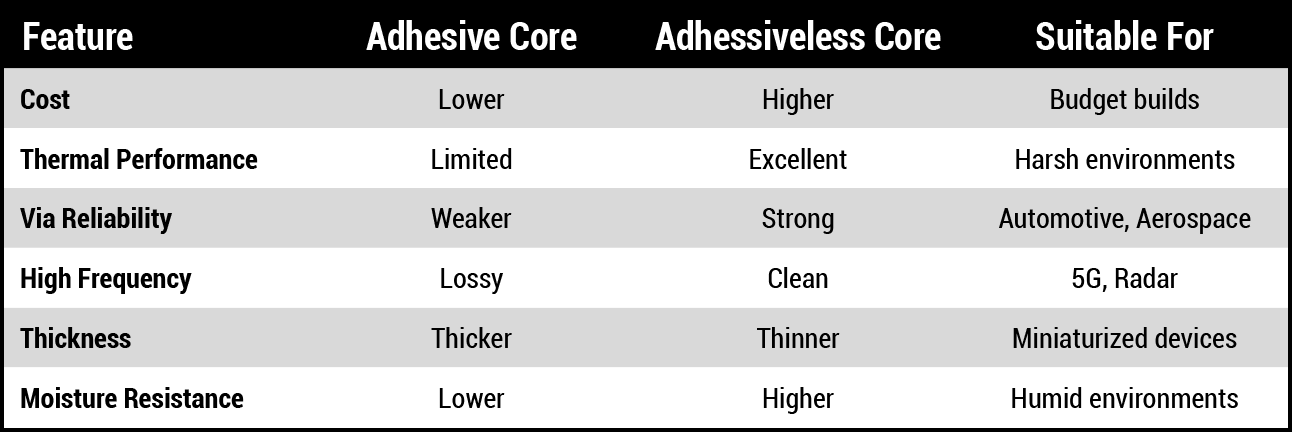
- Thermal bottleneck. Adhesives can’t handle heat like pure polyimide can. They may soften or outgas during soldering, causing delamination.
- Expansion mismatch. Adhesives expand more with heat than copper or polyimide. This puts stress on vias, leading to cracks over time.
- Signal loss. Adhesives have higher electrical loss at high frequencies, reducing signal clarity in GHz circuits.
- Added bulk. Adhesive layers make the core thicker and less flexible.
- Moisture absorption. Adhesives soak up more water, which can turn to steam during soldering and cause blistering.
Adhesive cores are like a family sedan. Affordable, dependable, perfect for everyday commutes. But ask it to run a Formula 1 track, and it starts to show its limits.
Adhesiveless Polyimide Cores – A Smarter Solution
Enter the adhesiveless core. Instead of gluing copper to polyimide, engineers figured out ways to bond them together directly (Figure 3).

Two common methods are typically used. In the cast polyimide process, liquid polyimide is applied directly onto copper foil and then cured, forming a seamless bond between the materials. In the second method, the polyimide film undergoes surface treatment and is seeded with a thin metal layer through sputtering, after which copper is plated onto the surface to complete the bond.
Benefits of adhesiveless cores. Adhesiveless cores offer several advantages. They provide strong thermal endurance, permitting exposure to lead-free soldering and harsh operating environments without degradation. Because the copper and polyimide expand at more similar rates, they deliver improved dimensional stability and reduce stress on vias. They also support better high-frequency performance with lower signal loss, making them well-suited for applications such as 5G and radar. Without an adhesive layer, the construction is thinner and lighter, enabling slimmer device designs. In addition, pure polyimide absorbs less moisture, reducing the risk of soldering-related defects.
Limitations of adhesiveless cores. Adhesiveless cores bring a variety of tradeoffs. This technology is generally more expensive to produce, as it requires specialized materials and tighter process control. The manufacturing process itself is more complex, often demanding advanced equipment and technical expertise. In addition, integrating very thick copper layers can be more challenging compared to adhesive-based constructions. If adhesive cores are sedans, adhesiveless cores are Formula 1 cars. Costly, precise and not for everyone, but unbeatable when conditions are demanding.
Making the Best Choice
So, which option is really better? It depends on the needs. Both adhesive and adhesiveless cores have unique strengths, and the right choice depends on cost, performance and the environment the board will operate in.
Adhesive cores make sense when:
- Budget is the priority (consumer gadgets, appliances).
- The environment isn’t too harsh.
- Thick copper is needed for power; and
- Speed and supply chain familiarity matter.
Adhesiveless cores are the best choice when:
- Reliability is non-negotiable (aerospace, automotive safety, medical devices);
- High-frequency performance is critical (5G, radar, high-speed servers).
- Extreme conditions are the norm (space, drilling, under-hood electronics).
- Devices must be thin, light, and compact (wearables, smartphones).
The Key Point
The decision whether to use adhesive or adhesiveless polyimide cores may seem like a technical footnote, but the choice involves performance, reliability, size and cost.
- Adhesive cores remain the dependable, cost-effective backbone of countless devices.
- Adhesiveless cores enable cutting-edge applications from foldable phones and wearables to aerospace systems and medical implants.
As electronics keep pushing boundaries, e.g., faster, smaller, hotter and lighter, then adhesiveless cores are stepping into the spotlight. The next time you look at your latest device, keep in mind that it is not just the chips that matter, but also the unseen materials working behind the scenes to make it reliable.End of article content
Akber Roy is CEO and founder of RUSH PCB Inc. (www.rushpcb.com) an electronics manufacturing company specializing in PCB design, fabrication and assembly services; roy@rushpcb.com.