

IPC-2581 Adoption Summit 2026: Intelligent Data Exchange Between Design Houses and Manufacturing Partners
The third annual summit at PCB West highlighted real-world adoption, industry collaboration and the next generation of intelligent PCB data exchange.
The third annual IPC-2581 Adoption Summit took place Oct. 1, 2026, at PCB West in Santa Clara, CA. It brought together OEMs, PCB fabricators, contract manufacturers and software suppliers to discuss an important question: How can the industry accelerate its transition from traditional PCB manufacturing data packages to intelligent, digital data exchange?
The discussions did not question whether IPC-2581 works. Companies already use IPC-2581 in production. Instead, participants shared experiences, discussed how to overcome adoption challenges and collaborated on innovations that can benefit the entire PCB design and manufacturing supply chain.
Representatives from leading OEMs, VGT, WUS, Dynamic Electronics, IFOUND PCB, Cadence, Aegis, Polar Instruments, Vayo and others participated. Some have used IPC-2581 for years, while others are just beginning their journey. IPC-2581 no longer serves simply as a replacement for Gerber. It is changing how the industry communicates design and manufacturing intent.
By the industry, for the industry. Twelve founding members established the IPC-2581 Consortium in 2011. Today, it includes more than 140 member companies representing the PCB design and manufacturing ecosystem: OEMs, EDA/DFM/CAM software suppliers, PCB fabricators, electronics assemblers and test companies. Its mission is to accelerate adoption of IPC-2581 as an open, neutrally maintained global standard that encourages innovation, improves efficiency and reduces costs. What’s not to like?
The Consortium does much more than promote a data format. Its greatest strength is collaboration. Members identify problems affecting the industry, develop solutions, incorporate those solutions into the standard and help companies implement them, including companies that do not belong to the Consortium.
With a proprietary format, innovation depends on the format owner’s priorities, resources and release schedules. Even when users identify an important requirement, changing the format can be difficult at best, and rolling the change out across the ecosystem and into end users’ hands can take considerably longer. The IPC-2581 Consortium gives the industry a forum to identify needs, propose enhancements, review them through an open standards process and help drive implementation. Changes still require work, but industry needs, rather than a single proprietary-format owner, set their direction.
IPC-2581 is by the industry, for the industry.
Three years of adoption summits and growing momentum. The Consortium held its first IPC-2581 Adoption Summit right after PCB West in 2024. The objective was to bring companies across the PCB ecosystem together to share adoption experiences, identify obstacles and collaboratively develop solutions. The 2026 meeting marked the third summit at PCB West.
The Consortium holds the annual Adoption Summit the day after the PCB West exhibit day. This year, at the request of members who attended the summit, the Consortium also held an IPC-2581 update meeting at IPC APEX EXPO 2026 to share progress and engage more of the industry.
These meetings go beyond presentations about a standard. They are working sessions in which members discuss what works, what doesn’t and what needs to improve. This year’s summit included show-and-tell sessions that showed participants how easily they can use IPC-2581 to, for example, eliminate the fabrication and assembly drawings that often cause 25% to 50% of (unnecessary) technical questions (TQs).
The Consortium maintains a Top 10 list of priorities for accelerating adoption and reviews progress against those priorities. Table 1 highlights in yellow the items on which the Consortium has made progress.
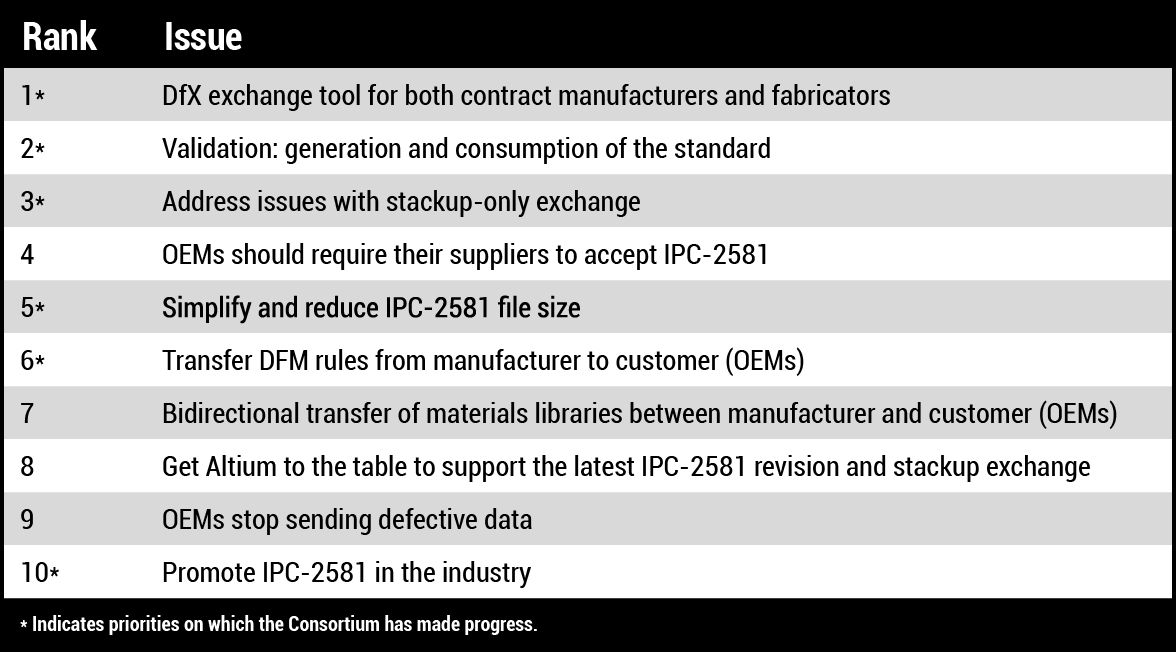
Table 1 shows how the Consortium translates industry feedback into concrete activities, and where it needs additional collaboration and participation.
Adoption is happening: the numbers tell the story. One of the most encouraging parts of the summit was hearing about actual deployments, not just plans.
- One OEM reported that it has fabricated and assembled more than 150 different PCB designs using IPC-2581 over the past 12 months.
- Aegis reported that more than 33 of its EMS and contract manufacturing customers worldwide have used IPC-2581 over the past decade.
- A large, influential OEM uses IPC-2581 internally and is working toward bidirectional data exchange with manufacturing partners.
- Polar Instruments implemented IPC-2581 Revision C import/export for stackup exchange in response to OEM requirements.
- Cadence continues to enhance its IPC-2581 implementation based on customer needs and collaboration with other Consortium members.
These examples demonstrate that adoption extends beyond one supplier or manufacturing process. Companies can start with stackup-only exchange, move to fabrication data, expand into assembly and eventually use bidirectional DFM exchange. There’s no need to change everything at once.
Why Move to IPC-2581?
Protect your intellectual property. One of IPC-2581’s most valuable capabilities is protecting intellectual property through function modes. Traditional manufacturing handoff packages contain considerably more information than a particular partner needs. Why should an assembly house receive all the information a fabricator needs? Why should a stencil manufacturer receive unrelated design details?
IPC-2581 allows users to generate packages appropriate to a particular operation, including fabrication, assembly, test, stencil, BOM, DfX and other user-defined modes. Send partners the information they need to do the job, not everything in the design.
Eliminate unnecessary fabrication and assembly drawings. Traditional manufacturing packages rely heavily on drawings to communicate requirements the artwork does not capture. A drawing may lag behind a design change, a note may be ambiguous, or a manufacturer may need clarification about which objects a requirement applies to.
Vince DiLello of Cadence demonstrated how designers can electronically attach manufacturing specifications to design objects and export them in IPC-2581. For example, a designer can attach a via-plugging requirement directly to the applicable vias. Other examples include impedance, tolerances, fabrication instructions and assembly specifications.
Cadence has supported this capability since 2021 and recently enhanced it to allow multiple specification definition files and sharing among designers. Many users remain unaware of it. Rather than automate the creation of potentially inconsistent drawings, why not eliminate the need for many of them?
Reduce manufacturing data preparation time and avoid errors. Dana Korf offered a fabricator’s perspective. Gerber originated more than 70 years ago, and conventional handoff still requires significant interpretation and reconstruction. Fabricators receive artwork, drawings, drill files, netlists, spreadsheets and other documents that may conflict or omit important information.
Korf described IPC-2581 imports that take less than one minute, compared with 20 minutes to more than eight hours for some traditional packages. These figures reflect participants’ experience rather than industry-wide benchmark averages, but they illustrate the opportunity.
Fabricators often correct incoming data without charging the customer. Each interpretation or correction, however, can introduce a difference from the original design intent. The goal should be to manufacture what the designer intended, without reconstructing that intent.
Exchange stackup information electronically, before layout. One of the Consortium’s earliest innovations, stackup-only exchange, dates to around 2014–2015. High-speed PCB designers and fabricators collaborate early on materials, layer structures, thicknesses and impedance requirements. Traditionally, recommendations arrive in spreadsheets, drawings and emails, and designers must manually re-enter them into PCB design tools.
IPC-2581 allows intelligent stackup information to move electronically in both directions. Polar Instruments discussed its Revision C import/export implementation. This eliminates unnecessary re-entry, reduces errors and helps teams avoid mismatches they might otherwise discover late in the design cycle.
Move technical questions from email to digital exchange. Fabricators and designers still often exchange TQs through emails, spreadsheets, screenshots and documents. Someone forwards each question to the appropriate engineer, who answers it, and then someone manually connects the answer back to the correct PCB revision.
IPC-2581 Revision C introduced the DfX module for electronic exchange of DfM data and TQs, and version 4.0 enhances these capabilities. DiLello discussed Cadence’s ongoing vision for an IPC-2581-based digital TQ workflow. The envisioned system would associate questions with board revisions, route them to responsible engineers, manage priorities and deadlines and integrate with enterprise tools.
Importantly, the complete design database need not travel with each question. Users can exchange relevant information separately and securely. Analytics could also reveal recurring issues, training opportunities and supplier trends. The objective is not simply to send emails faster; it is to make the communication itself intelligent.
Improving Interoperability Through Validation
As adoption grows, interoperability becomes increasingly important. Generating an IPC-2581 file does not guarantee that every element conforms to the schema or that every receiving tool will interpret it correctly.
Terry Hoffman of Cisco demonstrated IPC2581 Check, a schema validation tool that identifies nonstandard attributes, invalid structures and other issues. In one real-world case, it detected repeated elements where the schema allowed only one; the vendor confirmed and corrected the error. Cisco has approved an open-source release, and its internal publication process is underway.
This is another example of collaboration benefiting the industry: A shared validation capability can help both producers and consumers of IPC-2581.
Making the transition: lessons from the field. One of the biggest barriers often isn’t technical; it’s resistance to change. Organizations have invested years in Gerber scripts, procedures, automation and supplier relationships. Summit participants advised against replacing everything overnight and recommended proceeding collaboratively and systematically:
- Count TQs, emails, engineering hours, documentation discrepancies and supplier data-preparation time.
- Generate IPC-2581 alongside your traditional package and compare the results internally.
- Choose a previously manufactured, known-good PCB for a pilot.
- Send both packages to your manufacturing partner and jointly review the differences; some may reveal issues in the traditional package.
- Repeat across several designs until both parties feel confident.
- Engage suppliers early: “We want to move to IPC-2581. How can we work together to make this successful?”
What’s next? Version 4.0 and the digital factory. Summit participants reviewed IPC-2581 version 4.0 and related standards work. The Consortium is also working on DfM rules exchange and on updates to IPC-9252, the electrical test standard. The updates would recognize IPC-2581 and ODB++ rather than relying solely on Gerber, and would reconsider requirements for separate netlists when equivalent intelligent data already exists.
Collaboration makes the difference. No single OEM, software supplier, fabricator or assembler can solve every challenge of digital manufacturing exchange alone. The Consortium offers a forum where competitors collaborate on a common standard while continuing to differentiate their products and services. An OEM identifies a missing capability; a fabricator explains the impact; a software supplier helps implement it; others review, validate and improve the result.
The development priorities of a proprietary format should not constrain innovation. The industry needs a standard that can evolve with its requirements. That is the promise of IPC-2581, and the strength of the Consortium behind it.
The time to begin is now. The third Adoption Summit demonstrated that intelligent PCB data exchange is happening today. One OEM’s production experience, Aegis’ EMS/CM adoption, a large, influential OEM’s move toward bidirectional supplier exchange, Polar’s stackup exchange implementation, Cadence’s manufacturing specifications and the emerging digital TQ workflow all point in the same direction.
Start with one known-good design. Generate IPC-2581. Compare it with the traditional package. Work with your manufacturing partner. Learn from the differences and repeat.
If you encounter challenges, reach out to the IPC-2581 Consortium. Members across the design and manufacturing ecosystem will share their experience and expertise. Visit ipc2581.com for information and the software support matrix, or contact info@ipc2581.com.End of article content

Hemant Shah is an EDA veteran and chair of the IPC-2581 Consortium (ipc2581.com). Shah led the effort to create an industry-wide consortium of design and supply chain companies to get IPC-2581 – the standard for transferring PCB design data to manufacturing – adopted.
He spent 20 years at Cadence as product manager for various PCB design products. Shah also led the industry adoption of the IBIS-AMI algorithmic modeling standard. Prior to joining Cadence, Shah worked at Xynetix and Intergraph. He is passionate about developing and marketing leading-edge software products for PCB design.