

AI Computing Surge Reshaping PCB Material Landscape
Taoyuan, Taiwan – As AI computing continues to drive a comprehensive upgrade in hardware specifications, the global printed circuit board industry is undergoing a profound structural transformation. According to a report released in May by the Taiwan Printed Circuit Association (TPCA) and the Industry, Science and Technology International Strategy Center (ITRI), the global copper-clad laminate (CCL) market is expected to exceed $21.5 billion in 2026, driven by AI demand, with annual growth projected to reach 34%.
While Taiwanese suppliers have established competitive advantages in high-speed materials and key process consumables, high-end IC substrate materials and glass fabrics remain largely dominated by Japanese manufacturers. In response to supply bottlenecks and geopolitical uncertainties, Taiwan’s supply chain is accelerating high-value positioning through deeper independent R&D, further strengthening its critical role in the global AI supply chain.
In the CCL sector, strong demand from AI servers for large-format, high-layer-count PCBs with more than 40 layers and ultra-low-loss characteristics has placed the market in a strong growth cycle driven by both volume and pricing. The global CCL market reached $16 billion in 2025 and is forecast to expand sharply to $21.5 billion in 2026, supported by AI-related specification upgrades, representing annual growth of up to 34%.
As of 2025, Taiwanese suppliers held a combined global market share of 37% in this segment, with Elite Material the global leader at 19%. To address high-speed transmission requirements, Taiwanese suppliers are also actively developing next-generation materials such as low Dk2 glass fabric, quartz fabric and PTFE, aiming to strike an optimal balance between high-speed signal integrity and processing reliability, and to reinforce the material foundation for high-performance computing.
Flex circuit materials. In the flexible copper-clad laminate (FCCL) market, polyimide benefited from demand for battery management systems and advanced driver assistance systems in electric vehicles, as well as a recovery in the PC market. These factors lifted the market size to $1.01 billion in 2025. Rising memory prices have increased downstream device costs, however, and polyimide output value is projected to edge down slightly to $990 million in 2026.
In high-frequency applications, MPI and LCP remain key materials for advanced communications. Growth momentum has been constrained by moderate smartphone market expansion and design changes, however. The MPI market is forecast to reach approximately $240 million in 2026. Meanwhile, LCP, known for its ultra-low-loss advantages, saw demand decline by more than 10% in 2025 due to changes in iPhone antenna designs. Looking ahead to 2026, the market is expected to remain weighed down by weak consumer electronics demand, with overall scale estimated at around $280 million.
IC substrate materials. Japanese manufacturers continue to maintain a high level of technological dominance in semiconductor substrate materials, extending their influence to the very upstream end of the industry chain. Data for 2025 show that in the ABF substrate materials market, Ajinomoto held a 97% market share, effectively controlling a critical material supply point for global AI chip packaging.
Japanese suppliers also held more than 70% market share in BT substrate materials and low-CTE glass fabrics. Since AI applications are relatively less price-sensitive, suppliers have prioritized AI-related orders, resulting in structural supply bottlenecks. This has even begun to affect capacity allocation for automotive and traditional consumer electronics glass fabrics.
High-end raw materials. As AI servers evolve toward B300 and GB300 platforms, the PCB supply chain is benefiting from both higher value-added requirements and incremental demand growth. Taking HVLP copper foil as an example, demand for HVLP4 products with extremely low surface roughness, such as Rz 0.5μm, is rising rapidly. Driven by the AI wave, global HVLP copper foil capacity grew 48% in 2025 to 23,400 metric tons. Japanese suppliers currently account for more than 60% of supply.
At the same time, the high-layer-count and thick-board structure of AI servers has significantly increased processing complexity, directly raising technical requirements for PCB drill bits, a key process consumable. To address challenges such as chip evacuation and drill breakage, the market is accelerating its shift toward high-performance coated drill bits to enhance processing stability. As microvia drilling shortens drill-bit service life, the global drill-bit market climbed to $860 million in 2025. In 2026, supported by rising drilling volume and the high-value transformation of consumables, drill-bit output value is expected to grow 29% to $1.11 billion.

Hot Takes
The AI memory chip boom could slow by 2028 as Chinese chipmakers rapidly expand DRAM and NAND production capacity and global AI spending growth moderates. (Samsung)
Growing shortages of advanced build-up substrates for AI, server and networking packages are increasing as layer counts and larger substrate sizes strain industry capacity. (TechSearch International)
MLCC prices are expected to rebound due to rising demand from high-end applications and increased channel stocking activities for consumer-grade components. (TrendForce)
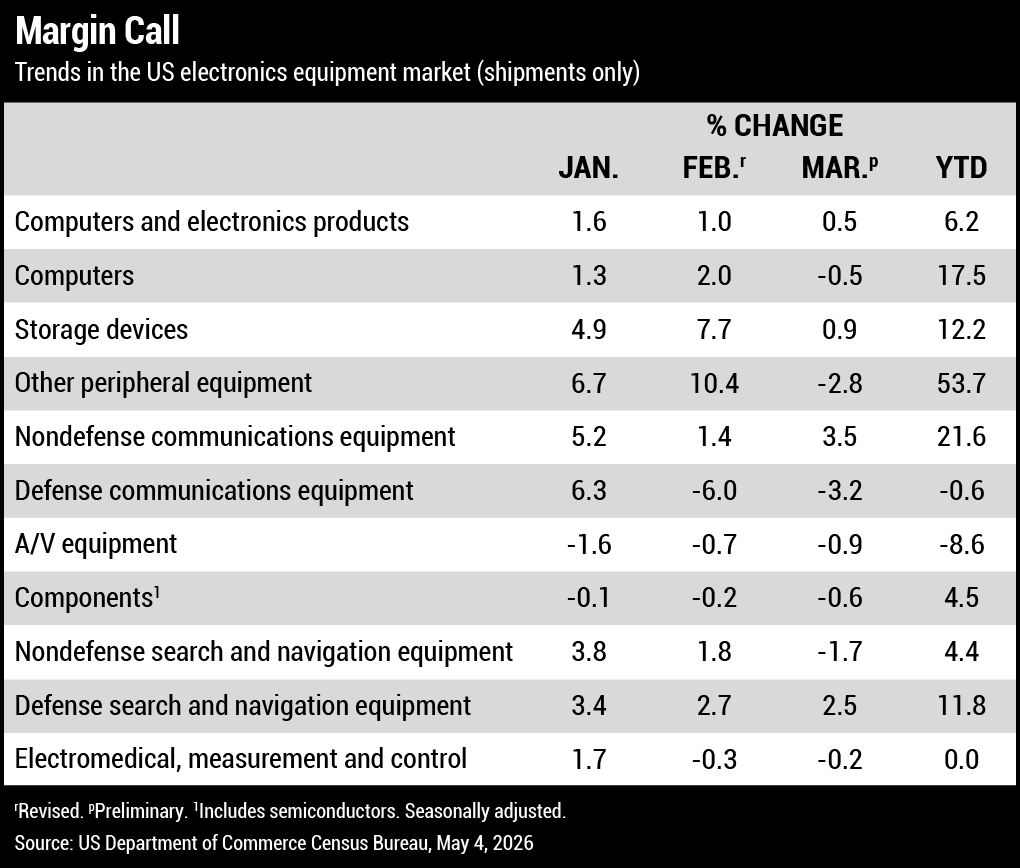
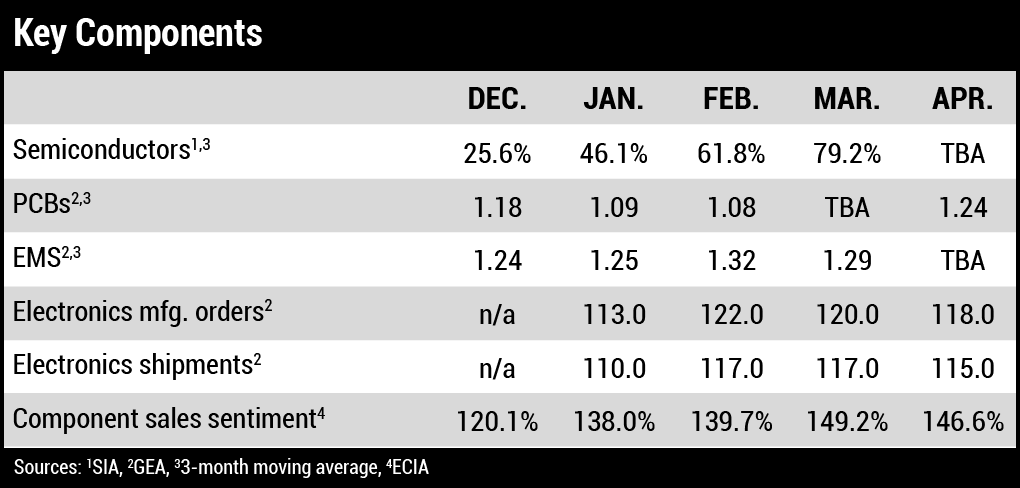
Global semiconductor sales reached $299 billion in the first quarter, up 25% from the fourth quarter of 2025. March sales totaled $99.5 billion, increasing 79% year-over-year and 11.5% sequentially. (Semiconductor Industry Association)
North American PCB shipments rose 5.8% in April from the previous year, and 15.6% sequentially. Year-to-date are up 8.9%. Bookings climbed 25.5% year-over-year and 36% sequentially, and are up 4.1% for the year. (GEA)
Growing concern over US dependence on Chinese rare earth supplies is increasing attention on recovering valuable magnets and materials from domestic electronic waste to support electronics, defense and AI-related industries. (Chatham House)
Global semiconductor materials revenue rose over 6% to a record $73 billion in 2025. (SEMI)
AI-driven demand for higher-performance computing hardware is accelerating growth in the copper-clad laminate market as Taiwan’s PCB supply chain pushes to secure second-source materials capacity. (TPCA)
Global server shipments rose about 4% sequentially in the first quarter, with agentic AI driving demand for both GPUs and CPUs and boosting growth in general-purpose servers. (DigiTimes)
Global silicon wafer shipments rose 13% year-over-year to 3.28 billion square inches in the first quarter. (SEMI)
The top five North American cloud service providers (CSPs) will significantly increase their procurement of rack-scale AI servers in 2026 to expand the deployment of AI training and inference models. (TrendForce)End of article content