

By 2030, China Aims to Become a Global Automotive Powerhouse
BEIJING – Beijing wants you to believe the future of the automobile is already decided. On Sept. 10, nine Chinese ministries – from the National Development and Reform Commission down to the Cyberspace Administration, because nothing in China’s industrial policy gets one signature when nine will do – rolled out the 15th Five-Year Plan for Intelligent Connected New Energy Vehicles. The headline: by 2030, China intends to lock up “global automotive power” status for good.
The numbers, as always with these documents, are precise to the point of theater. New energy passenger vehicles at 70% of domestic sales, commercial at 40%. Autonomous driving “at scale.” Fuel economy down to 3.3 liters per 100km for combustion vehicles, 11.5kWh per 100km for EVs. Highways and “some” urban roads handling highly automated driving. Labor productivity up 15% over 2025. A handful of homegrown automakers cracking the global top 10 in sales, and parts suppliers cracking the top 100. Carbon peak by 2030. Safety systems that beat human drivers, stated as fact rather than target.
It’s an impressively tidy plan for an industry that, in the rest of the world, doesn’t move in straight lines. Supply chains don’t hit five-year checkpoints on schedule, and “highly autonomous driving” has a way of staying five years out no matter which five years you’re in. What the plan does confirm, whether China clears every bar it set for itself, is the direction of travel: state resources aimed squarely at owning the vehicle electronics and software stack, not just the sheet metal. For anyone in PCB fabrication, EMS, or component supply watching China’s share of automotive electronics demand, that’s the part of this release that matters more than the fuel-economy decimal points.
The industry will spend the next four years finding out how much of this is delivered and how much is aspiration wearing an official seal. Worth watching either way.
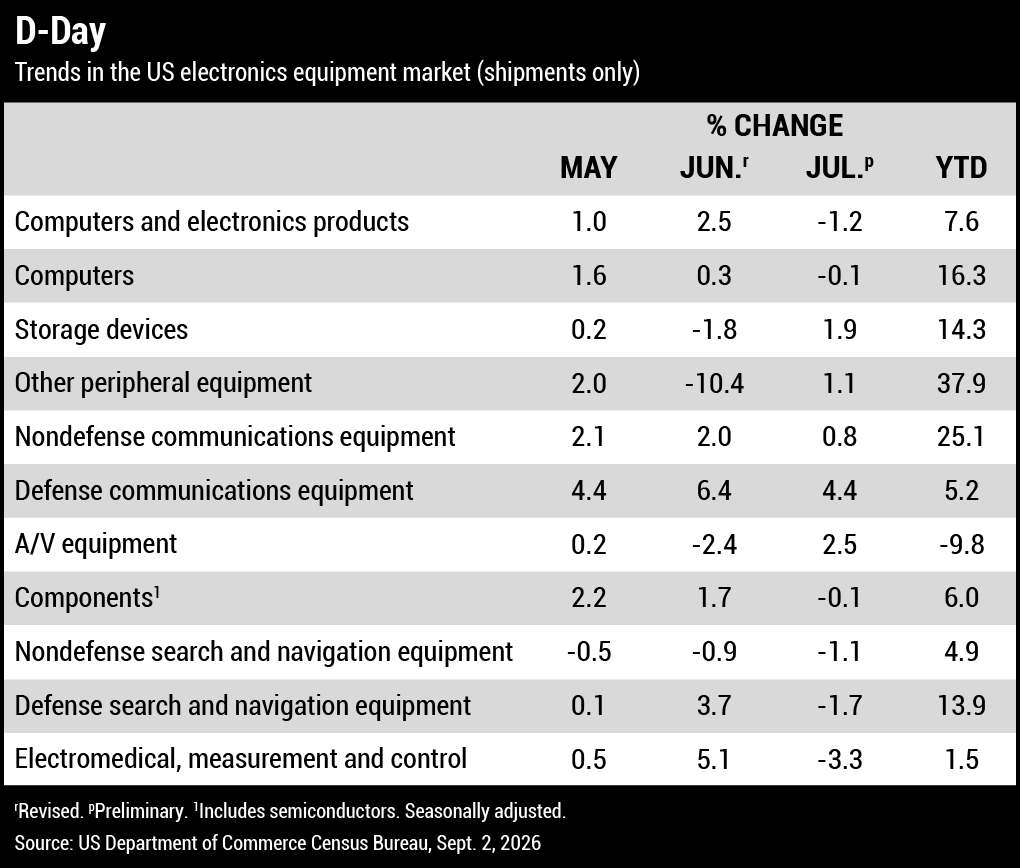

Quick Hits
The worldwide server market reached a record $166.3 billion in vendor revenue in the second quarter, surpassing the previous high of $125.3 billion set in the fourth quarter 2025. The result marks a 52% year-over-year increase and a 35.7% sequential gain. (IDC)
Vietnam is moving to strengthen domestic electronics and semiconductor supply chains after exports reached an estimated $101 billion in the first eight months of 2026. (Vietnam Electronic Industries Association)
The global specialty chemicals market for PCB pulse plating is projected to grow to $483 million by 2032 from $221 million in 2025. (QYResearch, Inc)
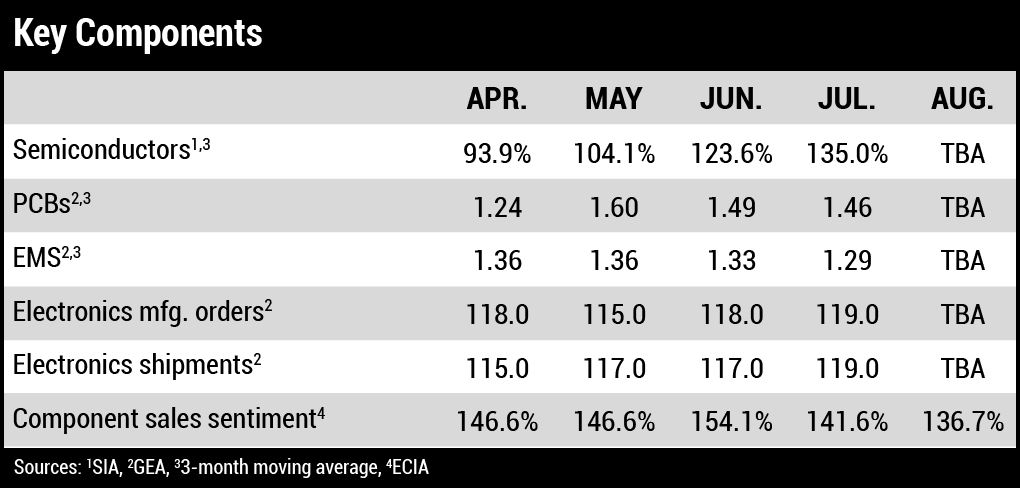
Global semiconductor sales reached $146 billion in July, up 6% sequentially and 135% year-over-year. (SIA)
Factory activity expanded across much of Asia in August as strong demand for semiconductors, computers and other AI-related hardware boosted manufacturing in China, Japan and South Korea. (S&P Global’s Eurozone Manufacturing Purchasing Managers’ Index)
The global PCB assembly market is projected to grow from $102 billion in 2025 to $168 billion by 2035. (SNS Insider)
Philippine electronics exports could reach a record $54 billion in 2026, and the annual growth forecast rose to 10%. (SEIPI)
Surging AI demand is crowding out upstream material capacity for display panels, which is expected to drive total TV panel costs up 4-7% sequentially in the fourth quarter. TV panel demand by unit is projected to decline 4% in the period. (TrendForce)
Worldwide hardcopy peripherals shipments declined 7% year-over-year to 17.2 million shipments in the second quarter. (IDC)
Semiconductors for AI will grow to $1.5 trillion by 2031 (Yole Group)End of article content