



July 2026

This issue of PCD&F / CA is brought to you by:


FIRST PERSON
MONEY MATTERS
TECH TALK
DEPARTMENTS
July 2026 • VOL. 43 • NO. 7

FEATURES
Bandwidth Optimization (cover story)
How a ground guard sheet enables coplanar waveguide designs to overcome the 100GHz bandwidth limit in advanced mmWave applications.
by Chang Fei Yee
Process Validation
A step-by-step approach to specifying, validating and monitoring PCB backdrill requirements during NPI and production.
by Joe Clark
Mixed Stackups
Applying UHDI only where density and performance demands require it can reduce layer counts, improve yields and lower costs without sacrificing electrical performance.
by Anaya Vardya
Pogo Alignment
Improving pogo pin alignment during reflow with a stencil aperture modification that meets customer specifications.
by Akber Roy
Mentorship Matters
Two designers discuss mentorship, industry awareness and why more people should consider careers in electronics manufacturing.
by Ryann Howard
ON PCB CHAT (pcbchat.com)
with Mike Konrad
with CJ Clark
with Dr. James Maisir




PCEA
PO BOX 237
PORTSMOUTH, NH 03802
PCEA BOARD OF DIRECTORS
Stephen V. Chavez, CHAIRMAN
Susy Webb, VICE CHAIRMAN
Justin Fleming, SECRETARY
Anaya Vardya, TREASURER
MEMBERS
Jim Barnes
Michael Buetow
Tomas Chester
Douglas Dixon
Juan Frias
Richard Hartley
Matthew Leary
Charlene McCauley
Eriko Yamato
pcea.net
PUBLICATION
- PCD&F/Circuits Assembly digital.pcea.net
WEBSITES
- PCD&F pcdandf.com
- Circuits Assembly circuitsassembly.com
NEWSLETTER
- PCB Update pcbupdate.com
PODCASTS
- PCB Chat pcbchat.com
EVENTS
- PCB West pcbwest.com
- PCB East pcbeast.com
EDUCATION
- PCB2Day pcb2day.com
- PCEA Training pceatraining.net
- Printed Circuit University printedcircuituniversity.com
AWARDS PROGRAMS
- Service Excellence Awards pcea.net/sea-awards
- NPI Awards pcea.net/npi-awards


MANAGEMENT
PRESIDENT
Mike Buetow 617-327-4702
mike@pcea.net
mike@pcea.net
VICE PRESIDENT, SALES & MARKETING
Frances Stewart 770-361-7826
frances@pcea.net
frances@pcea.net
COLUMNISTS AND ADVISORS
Jeffrey Beauchamp, Dan Beaulieu, Peter Bigelow, Robert Boguski, John Burkhert, Jr., Stephen V. Chavez, Mark Finstad, Nick Koop, Jake Kulp, Alun Morgan, Susan Mucha, Greg Papandrew, Hemant Shah, Chrys Shea, Jan Vardaman, Gene Weiner
PRODUCTION
ART DIRECTOR & PRODUCTION
blueprint4MARKETING, Inc.
production@pcea.net
production@pcea.net
Nathan Hoeller
nathan@pcea.net
nathan@pcea.net
SALES
VICE PRESIDENT, SALES & MARKETING
Frances Stewart 770-361-7826
frances@pcea.net
frances@pcea.net
Senior Sales Executive
Will Bruwer 404-313-1539
will@pcea.net
will@pcea.net
EVENTS/TRADE SHOWS
EXHIBIT SALES
Frances Stewart 770-361-7826
frances@pcea.net
frances@pcea.net
TECHNICAL CONFERENCE
Mike Buetow 617-327-4702
mike@pcea.net
mike@pcea.net
WEBINARS
Andy Shaughnessy 770-315-9901
PRINTED CIRCUIT DESIGN & FAB/CIRCUITS ASSEMBLY is distributed without charge to qualified subscribers. To subscribe, visit pcdandf.com or circuitsassembly.com and click on Subscribe.
For changes or cancellations to existing subscriptions: subscriptions@pcea.net
PRINTED CIRCUIT DESIGN & FAB/CIRCUITS ASSEMBLY is published monthly by Printed Circuit Engineering Association, Inc., PO Box 237, Portsmouth, NH 03802. ISSN 1939-5442. GST 124513185/ Agreement #1419617.
© 2026, by Printed Circuit Engineering Association, Inc. All rights reserved. Reproduction of material appearing in PRINTED CIRCUIT DESIGN & FAB/CIRCUITS ASSEMBLY is forbidden without written permission.
THE ROUTE

MIKE
BUETOW
BUETOW
PRESIDENT
As the Chair Turns, One Last Time
Twenty-six years. That’s how long I’ve sat in this chair as an editor for this publication. Long enough that a reader or two out there was born right about the time I took the job, in January 2000, first as editor in chief of PC FAB, to which my then-boss Pete Waddell soon added Printed Circuit Design, and then, in 2005, CIRCUITS ASSEMBLY. (Now I really feel old. Thanks a lot.)
I mention it not to be sentimental – though I’ll ask your indulgence for a little of that – but because this is the last editorial I’ll write from this vantage point. After more than a quarter century, I’m handing over the keys. More on that in a moment.
First, a confession. Across all those years and all those issues, I never missed one. Over 318 consecutive issues (which must be an industry record, however dubious), not a single deadline was skipped. I wrote editorials on three continents and over two oceans. I wrote one on my honeymoon. And I wrote one from a hospital recovery room the day my first son was born – because with little else to do, I’d started counting the circuit boards in the equipment around me. (I’m a nerd. I have the receipts.)
READ FULL ARTICLE
Around the World
news
Principal Mineral Acquires Isola, Secures $280M for Expansion
DALLAS – Principal Mineral in June acquired PCB materials manufacturer Isola Group and secured approximately $280 million in new funding to support expansion, technology development and supply-chain investments. Financial terms of the deal were not disclosed.
The acquisition adds Isola’s copper-clad laminate and dielectric prepreg portfolio to Principal Mineral’s existing operations, which include Camden Copper, a producer of electrodeposited copper foil. Together, the businesses supply two key materials used in printed circuit board manufacturing, strengthening the company’s position in advanced electronics supply chains.

Kingboard to Expand PCB Capacity, Sells Stake in Laminate Unit
HONG KONG – Kingboard Holdings plans to raise approximately $1.5 billion through a stake sale in subsidiary Kingboard Laminates Holdings to expand production capacity and support growing demand for AI-related printed circuit board materials.
Kingboard Laminates, one of the world’s largest producers of copper-clad laminates, will use the proceeds to increase multilayer and high-density interconnect (HDI) PCB capabilities, expand manufacturing capacity, accelerate research and development efforts, and repay debt.
The move comes as AI infrastructure investment continues to drive demand throughout the electronics supply chain. Major cloud providers are expected to spend more than $800 billion on AI infrastructure in 2026, increasing demand for advanced PCB materials and manufacturing technologies.
READ FULL ARTICLEAT&S Announces $1.7B IC Substrates Expansion
LEOBEN, AUSTRIA – Citing continued strong demand for AI infrastructure and advanced packaging technologies, AT&S in June announced plans to invest €1.5 billion to €2 billion ($1.7 billion to $2.27 billion) to expand production capacity for high-end IC substrates.
The plans are supported by key customers, including AMD and another undisclosed technology company, AT&S said. The agreements will support the installation of additional production capacity at the fabricator’s existing plant in Kulim, Malaysia, and in a previously unused building of a second plant there.

TTM Completes $130M New York UHDI Facility
DEWITT, NY – TTM Technologies has completed construction of a $130 million advanced manufacturing facility in DeWitt, NY, expanding domestic production of ultra-high-density interconnect (UHDI) printed circuit boards for defense applications.
The 215,000-sq.-ft. facility, known as Syracuse Diamond, is expected to create up to 400 engineering and manufacturing jobs and increase TTM’s Central New York workforce to approximately 1,000 employees.
The project received $30 million in funding from the US Department of Defense and is intended to strengthen the domestic defense electronics supply chain. TTM said the facility will produce UHDI PCBs used in advanced military systems and support ongoing research and development efforts related to advanced packaging and substrate technologies.End of article content
Chase Acquires Sheldahl from Flex
WESTWOOD, MA – Chase Corp. in June completed its acquisition of Sheldahl from Flex, adding a portfolio of coated films, laminates and flexible circuit technologies used in aerospace, automotive, industrial and medical applications. Financial terms were not disclosed.
Sheldahl specializes in advanced materials and flexible circuitry, expanding Chase’s capabilities in specialty manufacturing and strengthening its position in high-reliability markets. Financial terms of the transaction were not disclosed.
The acquisition aligns with Chase’s focus on advanced materials and is expected to broaden its product offerings and market reach. Sheldahl’s technologies support a range of applications requiring lightweight, flexible and durable electronic solutions.
READ FULL ARTICLESchmid Plans New China Manufacturing Campus to Expand Capacity
FREUDENSTADT, GERMANY – Schmid Group has signed a preliminary agreement with local authorities in Zhongshan, Guangdong Province, to establish a new manufacturing campus in China aimed at supporting future growth and increasing production capacity.
The planned facility will consolidate the company’s manufacturing operations currently spread across two leased sites into a single company-owned campus. According to Schmid, the new site is expected to nearly double the effective manufacturing capacity of its existing China operations through expanded floor space, improved workflows and more efficient logistics.
The investment is part of Schmid’s “In China for China” strategy and is intended to support growing demand for advanced wet-process equipment used in the production of high-density interconnect boards, IC substrates, AI server boards and other advanced electronic applications.
Read Full ArticleGreen Circuits Changes Hands, Adds Canadian EMS
SAN JOSE – Green Circuits, one of the largest quickturn prototype electronics manufacturers in North America, changed hands in May. Financial terms were not disclosed.
Reichmann Segal Capital Partners in June acquired the EMS company from Praesidian Capital, which in turn had provided the capital to support Evolve Capital’s acquisition of Green Circuits in 2018. Reichmann Segal launched a fund, Metatron Private Equity, to acquire Green Circuits and

Polymatech Opens Singapore Hub for LED Packaging and Memory Module Assembly
SINGAPORE – Polymatech has opened an advanced electronics manufacturing facility in Singapore that will serve as its Asia-Pacific hub for LED chip-on-board (CoB) packaging and advanced memory module assembly.
Backed by an investment of approximately $25 million, the facility is located at Mapletree Hi-Tech Park and is designed to support optoelectronics, advanced packaging and computing applications. The site includes dispensing, packaging, curing, inspection, testing and module assembly systems for high-precision electronics manufacturing.

Nano Dimension Nears End of Strategic Review, Teases Next Move
WALTHAM, MA – Nano Dimension said it is nearing a decision on its long-term strategic direction after completing major restructuring efforts, divesting businesses and reducing operating expenses as part of a three-phase plan aimed at maximizing shareholder value.
In a letter to shareholders, CEO David Stehlin said the company has made significant progress since launching a strategic review in September 2025. The review was designed to streamline operations, reduce cash burn, monetize product lines and identify the most compelling path forward for the business.
Nano reported that standalone operating expenses declined approximately 22% year-over-year in the first quarter, while operating cash burn has fallen each quarter since the third quarter of 2025. The company also completed the sale of its AME and Fabrica product lines and announced the $42.5 million all-cash sale of MarkForged to Stratasys.
READ FULL ARTICLEInterflex Invests $18M to Expand Vietnam PCB Manufacturing
SEOUL – Interflex will invest approximately $18 million in its Vietnamese subsidiary, Korea Circuit Vina, as part of an ongoing effort to expand printed circuit board manufacturing capacity in Vietnam.
The investment will increase South Korea-based Interflex’s ownership stake in Korea Circuit Vina from 83.5% to 89.3%. Located in Vinh Phuc province, the facility serves as a PCB manufacturing base supporting the Korea Circuit Group’s regional production strategy.

Somacis Completes Acquisition of ACB Group
MILAN, ITALY – Somacis in late June completed its acquisition of France- and Belgium-based PCB manufacturer ACB Group, expanding its European manufacturing footprint and strengthening its position in the high-reliability printed circuit board market.
The transaction, first announced in February, includes ACB’s production facilities at Atlantec in Malville, France; Cibel in Bellême, France; and ACB NV in Dendermonde, Belgium. Financial terms of the deal were not disclosed.
The acquisition expands Somacis’ manufacturing, research and development, and customer support capabilities across Europe, complementing its existing operations in Italy, the United Kingdom and Switzerland. The company said the combined organization will be better positioned to serve customers requiring high-technology, high-reliability PCBs in demanding applications.
READ FULL ARTICLENCAB Acquires Board Shark to Expand US PCB Presence
SUNDBYBERG, SWEDEN – NCAB has acquired 100% of Florida-based Board Shark, expanding its US printed circuit board presence through a deal valued at up to $26 million.
The acquisition includes an upfront purchase price of $15 million, with an additional earn-out of up to $11 million tied to Board Shark’s financial performance over the next 24 months.
Founded in 2016 by Carl and Rachelle Moehring, Board Shark specializes in PCB solutions for customers in the aerospace, industrial and medical sectors, with a particular strength in quickturn deliveries. The company employs five people and maintains a network of regional sales representatives, giving it a strong presence in the western United States.
READ FULL ARTICLEAround the World
briefs
PCD&F
Meiko Group broke ground on a $500 million PCB manufacturing facility in Vietnam.
Nano Dimension has entered a nonbinding term sheet for a proposed merger with Infinite Epigenetics, an AI-powered preventive health and diagnostics company.
Saturn Electronics installed an Excellon Cobra Hybrid laser drill.
Samsung Electronics America plans to relocate its US headquarters from New Jersey to Plano, TX, by the end of the year, affecting approximately 1,000 employees.
Schmid Group reported more than $30 million in new orders from customers in China, Taiwan, South Korea and Europe since mid-May, driven by demand for advanced PCB and substrate manufacturing equipment used in AI infrastructure, high-speed networking and optical communication applications.End of article content
CA
Automated Production Equipment expanded manufacturing capacity for PCB eyelets and funnellets.
Benchmark Electronics has expanded its manufacturing partnership with Ouster to produce lidar sensors.
CE3S partnered with SpecialTeam to expand support for cleanroom and medical device manufacturers.
Celestica appears to be planning a new hub in Austin, including office space and an R&D lab focused on data server components.
Esprit Electronics purchased two Koh Young Zenith 2 AOI platforms.
Read Full Article

Around the World
PEOPLE
PCD&F


Dyconex named Jon Johnson director of sales, North America.
Lavelle Medical named David Ierardi VP of operations.
K2 Space Corp. named David Geurin principal PCB design engineer.
Vertiv named Claude Jodoin senior engineer core electronics.End of article content
CA


AIM Solder appointed Marcus Pee Nai Quan sales engineer for Southeast Asia.
Fuji America appointed Jonathan Wol senior director of sales and applications.
Green Circuits promoted Adam Szychowski to chief revenue officer.
Incap appointed Adam Ryder managing director of its UK electronics manufacturing operation, Murthy Munipalli president of Asia Pacific and Ralf Hasler president of Europe.
MicroCare named Doug Kay director of market and new business development.
Read full article
PCEA current events
national news
PCB West Keynote: The Physical AI Boom Starts at the Circuit Level
PEACHTREE CITY, GA – The Printed Circuit Engineering Association (PCEA) announced that AJ Cooper, CEO and cofounder of Itera, will keynote PCB West 2026.
His keynote, “The Physical AI Boom Starts at the Circuit Level,” takes place Sept. 30 from 11 a.m. to 12 p.m. at the Santa Clara (CA) Convention Center.
Itera, a new deep tech startup, has developed the world’s first “fluid” circuit board, which can rewire itself in real time. Built upon an electrowetting platform, the system replaces copper traces with reconfigurable liquid metal interconnects embedded in glass. When the design is updated digitally, the system reroutes the liquid metal traces to match the new design. The company says that this technology can make hardware iteration 1,000 times faster than the traditional PCB design process.
Read Full ArticlePCB West Assembly Program to Focus on Paste, Process Developments
PEACHTREE CITY, GA – PCB West this fall will feature a dedicated program of electronics assembly tracks, including nine sessions led by leading practitioners in solder paste, placement, reflow, stencil design and cleaning. The assembly program runs Sept. 29 and Sept. 30 at the Santa Clara (CA) Convention Center.
Spanning introductory through advanced material, the tracks give assemblers, process engineers and manufacturing professionals practical, noncommercial training on the core processes that determine circuit assembly yield and reliability. Registration is open at pcbwest.com.
The sessions kick off on Sept. 29 with A Data-Driven Solder Paste Qualification Process, a 3.5-hour workshop from Chrys Shea of Shea Engineering. There are numerous avenues by which assemblers can enhance reliability, reduce costs and increase the yields of their products through the qualification of a new solder paste. The problem they face is how to do it. Solder pastes have many properties to consider and test for, and there are many pastes to choose from. It can appear to be a daunting task, and a potentially risky one if something gets overlooked in the process. The solder paste selection scorecard simplifies the process.
Read Full ArticlePCEA Board Voting Begins this Month
PEACHTREE CITY, GA – Voting for nominees for the PCEA board of directors for the 2027-28 term will be circulated among PCEA individual members this month.
In accordance with PCEA bylaws, any PCEA member in good standing is eligible to be nominated for the board of directors. Board members are nominated by a nominating task group and voted on by the general membership, with ballots circulated a minimum of 60 days prior to the annual meeting.
The annual meeting takes place Sept. 29, 2026, at PCB West.End of article content
pcea current events
ASSOCIATION NEWS
PCB West 2026 features over 50 classes and more than 120 hours of in-depth electronics engineering training on circuit board design and assembly. Rick Hartley, Karen Burnham, Susy Webb, Stephen Chavez, and Tomas Chester are among the headliners of this year’s conference. Those who sign up by Aug. 21 can take advantage of the early bird special discounts for the conference.
Printed Circuit University in June added a new webinar on flex design and manufacturing. I Access to much of the content is free to individual members, while some extended tutorials are available via subscription.
Certification. The following recently passed the PCEA Certified Printed Circuit Designer exam:
- Troy Allman
- Albert Yang
- Alexander Yang
New Corporate Members.
Networking. The PCEA Discord server brings together engineers and designers from around the world on a private channel to discuss technical questions and career opportunities. To join, contact PCEA. Recent conversations covered specifying laminates, pin delays and stacking microvias.End of article content
CHAPTER NEWS
National. Upcoming PCEA Training Certified Professional Circuit Designer (CPCD) training and certification classes will be held:
- Sept. 4, 11, 18, 25, Oct. 9
- Sept. 28 – Oct. 2 (live abridged class, taught in-person in conjunction with PCB West)
- Oct. 16, 23, 30, Nov. 6, 13
Richmond, VA. The Richmond PCEA chapter on Jul. 1 is holding a PCB open discussion session. Drop in any time between 5 and 8 p.m. to discuss PCB design, schematics, layout, component libraries, manufacturing outputs, design challenges or ECAD workflows. Bring a project you’re working on, a question you’ve been stuck on, or just stop by to meet other engineers and designers in the area. We will have a laptop with KiCad and Altium installed, and attendees are welcome to bring other tools and projects to share. Whether you’re an experienced designer, a student, a hobbyist, or simply curious about PCB design, you’re welcome to come by.
No presentation, agenda, or commitment required – come for fifteen minutes or stay the whole evening. The location is Libbie Mill – Henrico County Public Library, 2100 Libbie Lake East St, Richmond.
Portland, OR. The next meeting is tentatively scheduled for July 23, from 12 – 1 p.m. Pacific. Speaker and meeting link to be announced.End of article content

Market Watch
AI Computing Power Demand Drives Upstream PCB Material Prices Wildly, Entering a ‘Super Cycle’
TAIPEI – Demand for upstream PCB materials is accelerating as AI servers push PCB layer counts and performance requirements to unprecedented levels, driving a sharp increase in the value of the materials used to build them.
According to industry data, successive generations of Nvidia’s computing platforms have dramatically raised the value of PCBs used in standalone AI racks. The H100 platform introduced in 2022 utilized roughly 16 to 20 layers, with PCB content valued at about $5,000 per rack. By the time the GB300 platform arrives in 2025, layer counts are expected to exceed 26 and PCB value per rack is projected to reach $35,000.
The next inflection point could come with Nvidia’s Rubin architecture, scheduled for volume production in the second half of this year. PCB stackups are expected to jump to between 32 and 40 layers, lifting PCB value per rack to approximately $116,000 – a 233% increase over the GB300 generation. By 2027, the Ultra architecture could require as many as 78 layers. (more)

Hot Takes
A bipartisan Senate bill would extend the Chips Act manufacturing tax credits to future semiconductor fabrication facilities in space, aiming to support US competitiveness in emerging microgravity chip production technologies. (Washington Times)
The global copper-clad laminate market is expected to exceed $21.5 billion in 2026, driven by AI demand, with annual growth projected to reach 34%. (Taiwan Printed Circuit Association and Industry, Science and Technology International Strategy Center)
Taiwan’s printed circuit board fabricators are expected to see domestic and overseas output rise 15% year-over-year to NT$1.05 trillion (US$3 billion) in 2026. (TPCA) (more)
roi

Peter
Bigelow
Bigelow
Why Humanoid Robots Aren’t Ready for the Factory Floor
Despite rapid advances in artificial intelligence, humanoid robots still face major hurdles in mobility, communication and energy efficiency.
With all the attention, headlines, discussion, expectations, hopes, fears and, yes, hype surrounding artificial intelligence (AI), there is one area that appears far from ready for prime time: humanoid robotics.
Some may argue that robotics is not really AI at all. That perspective comes from traditional automation, which has been used for decades to load and unload equipment, stock inventory in warehouses or move parts along assembly lines. These systems relied on straightforward programming tailored to specific tasks. In the 1990s, many printed circuit board companies had fleets of loaders and unloaders. More recently, warehouse automation was expected to revolutionize logistics. In both cases, productivity improved significantly, and the automation introduced was indeed transformative.
Today, however, both the technology and the expectations have changed.
Read Full Article
FOCUS ON BUSINESS

Jake
Kulp
Kulp
The Most Dangerous Word in EMS: Pretending
Successful EMS companies understand their strengths, acknowledge their limitations and avoid making promises their operations cannot support.
In the electronics manufacturing services (EMS) world, it is critical for companies to understand who they are and what they stand for, rather than adopting aspirational marketing taglines that make them appear indistinguishable from everyone else in the industry. Without that level of self-awareness, mistakes can occur when pursuing new business or serving existing customers.
Time for some honesty. Occasionally, nothing is more satisfying than a tall glass of cold milk and a homemade cookie. The comfort of a great piece of meatloaf with a side of mac-and-cheese, or a slice of pizza paired with a robust glass of cabernet, can be hard to beat. While none of these choices may qualify as health food, acknowledging the enjoyment they provide makes it easier to appreciate them without regret the next day.
The same principle applies to business. EMS companies benefit from recognizing and accepting the realities of their operations.
Read Full Article

Board Buying

Greg
Papandrew
Papandrew
Beating the NRE Game: Changing Designs Without Paying Tooling
Knowing which PCB specification changes require new tooling and which do not can help designers and buyers reduce nonrecurring engineering costs while avoiding unnecessary delays.
NRE (nonrecurring engineering) is a one-time fee charged by the fabricator for each revision of a design for a particular printed circuit board.
This fee covers the CAM engineering time, checking for design errors and providing a report for those items that need to be addressed. It also includes designing a sub-array panel that will work well for the assembler, generating photographic films or programming the LDI (laser direct imaging) machines, writing CNC drill and optimized routing programs and providing stackup details and material specifications.
There is often a separate fee for electrical test, test connectivity (including top-side pad connections to bottom-side pads), and programming the flying probe tester, or creating the electrical test (e-test) fixture, often dependent on quantity to be built.
Read Full ArticleON THE FOREFRONT

E. jan
vardaman
vardaman
ECTC Focuses on Challenges for AI Data Center Packaging and Energy Use
Thousands of attendees gathered at ECTC to explore the latest advances in advanced packaging, AI-driven design, heterogeneous integration and thermal management.
More than 2,700 attendees conversed about the latest developments in packaging and assembly at the IEEE Electronics Components and Technology Conference (ECTC) in May in Orlando.
Conference organizers dedicated the event to the memory of industry icon Dr. William (Bill) Chen, who was instrumental in the formation of the Heterogeneous Integration Roadmap and a visionary in the industry. During the keynote, Tien Wu, CEO of Advanced Semiconductor Engineering, highlighted Dr. Chen’s contributions and offered insights into advanced packaging trends and the future of system optimization.
Organizers devoted a full day to the Heterogeneous Integration Roadmap workshop, covering topics including additive electronics manufacturing for advanced packaging; metrology for advanced packaging, including challenges, innovations and industry impact; and emerging technologies such as neuromorphic computing.
Read Full Article
Designer’s Notebook

John
Burkhert, Jr.
Burkhert, Jr.
ICT vs. Flying Probe: Factory Testing of PCB Assemblies
From test coupons and burn-in chambers to ICT and flying probes, effective factory testing is essential for delivering reliable products and maintaining process control.
Factory testing comes in numerous flavors. The goal is to ship products that work in the field. Failures erode gross margins, which in turn affect the company’s market perception. Good customer relationships depend on the timely delivery of products that meet the requirements, which is the definition of quality. IPC-TM-650, Test Methods Manual covers the test procedures in detail.
This column covers the following topics:
- Disposition of defective materials
- Statistical process control
- Stress testing power delivery networks
- Bed-of-nails and flying probe test fixtures.
On the factory floor, units come off the line in rapid succession. Testing is performed, although resources for troubleshooting may not always be available. Rejected units may be recycled or repurposed after the removal of higher-value components, depending on the industry and component mix.
Read Full Articledesign best practices

Stephen V. Chavez
When the BoM Breaks the Design: Why Supply Chain Resilience Starts at the Engineer’s Desk
Supply chain disruptions may be inevitable, but the ability to design around them doesn’t have to be an afterthought.
If it feels like supply chains are back in the headlines again, that’s because they are. Only this time it’s not a pandemic driving the disruption; it’s geopolitics.
The current conflict between the US and Iran is yet another reminder of how interconnected and fragile the global electronics ecosystem has become. Semiconductor manufacturing depends on complex networks of raw materials, fabrication capacity, assembly operations, transportation infrastructure and energy resources spread across multiple regions of the world. When instability affects any one of those areas, the consequences can ripple across the entire product development lifecycle.
For those of us involved in electronics design, however, none of this should come as a surprise.
Read Full Article

ECAD Tips & Tricks

Martyn
Gaudion
Gaudion
PCB Stackups: A Brief History
The evolution of layer stackups, from simple constructions to sequential lamination.
Stackup, the buildup of PCBs, has grown in importance over the past few decades. In the early days PCBs functioned primarily as interconnect, and the need for stackup was minimal. On a single-sided PCB, the “stack” is simply one piece of clad material. Even the board thickness was rarely a consideration unless it had to plug into an edge connector.
With the advent of multilayer PCBs, however, the stack of materials is more critical and, as always, cost is often the underlying driver. Stackups can range from the simplest four-layer PCB to complex stackups requiring sequential lamination.
Let’s take the humble four-layer PCB. PCB designers not familiar with fabrication may be forgiven for thinking that the four-layer board consists of two double-sided rigid boards bonded together with an additional layer of unclad material. It may come as a surprise, then, that most four-layer boards are stacked as a central two-layer PCB with two sheets of copper foil laminated on the outside, with the bonding provided by a layer or two of glass cloth “pre-impregnated” with uncured resin (prepreg).
Read Full Article
Material Gains

Alun
Morgan
Morgan
Why Human Expertise Still Matters in High-Performance Computing
High-performance computing has moved out of its niche to become a mainstream requirement and continues to rely on human skills to deliver its optimum potential.
Historically, supercomputing has been a niche discipline, the preserve of rare and almost mythical machines embodying esoteric design principles. Only a tiny number of organizations, such as national laboratories, top-tier businesses and elite universities, had workloads that justified using them. Also, there were only a few engineers and scientists in the world capable of running them.
Now, thanks to several generations of technology scaling, compute performance is more readily and cheaply available at any level, from tiny, embedded microcontrollers to desktop machines, rack servers and hyperscale cabinets. Together with innovative concepts like Beowulf clusters, which build supercomputers from general-purpose off-the-shelf computers at a fraction of the cost, these have created a democratizing effect that has helped set the scene for practicable and affordable high-performance computing (HPC) as we know it today. The PCB industry has played its part, providing substrates that not only support high signal speeds but also critically address the thermal issues intrinsic to HPC.
Driving this ingenuity, of course, are the market dynamics affecting today’s businesses and research institutions. Companies can no longer rely on incremental product improvements or greater supply chain efficiency to compete for market share, and researchers seeking progress in increasingly complex fields need to deliver results quickly to meet funding obligations. The key to success in these times is computational. As more computing means greater advantage, more organizations need HPC to handle workloads such as retail demand forecasting, biotech simulations, financial risk modeling and digital twinning. While they may not be “supercomputer workloads” in the old sense, these are the challenges HPC was built for.
Read Full Article
Data Transfer

Hemant
Shah
Shah
It’s Time to Move Beyond Gerbers
As PCB designs grow more complex, IPC-2581 offers a different approach to manufacturing data exchange.
The electronics industry has spent decades perfecting PCB design tools, automating verification, embracing digital twins and accelerating product development using AI tools. Yet when it’s time to send a design to manufacturing, many organizations still fall back on a process that hasn’t fundamentally changed in decades – export Gerbers, generate drill files, create spreadsheets, collect PDFs, zip everything together, and email the package.
This isn’t happening because there isn’t a better alternative. It’s happening because old habits are hard to break.
Today, virtually every major PCB design system – including Cadence, Altium, Siemens Pads and Xpedition, Zuken CR-8000 Design Force, Pulsonix, KiCad and Easy-PC – can generate IPC-2581 directly from the PCB editor. There are no additional translators to purchase, no special software to install and no licensing costs to create the file. For most designers, generating IPC-2581 is simply another output option already built into the tool they use every day.
Read Full ArticleBandwidth Optimization
Breaking the 100GHz Barrier with Ground Guard Sheets in mmWave PCB Design
Breaking through the 100GHz bandwidth limit for coplanar waveguide design with a ground guard sheet in mmWave applications.
by Chang Fei Yee
Millimeter wave (mmWave), or millimeter band, is an electromagnetic (EM) frequency range below infrared (IR). The frequency spectrum of mmWave is applied for high-speed telecommunications, such as 5G and potentially 6G network deployment.1,2 Referring to Figure 1, the mmWave wavelength ranges from 10mm at 30GHz to 1mm at 300GHz.
Wireless communication in the mmWave band is fast and low-latency, enabling higher data rates than other telecommunications in lower-frequency bands, such as existing cellular networks. With its higher data rate and capacity, the mmWave network handles more data traffic than other frequency bands. Furthermore, mmWave does not propagate or interfere with the neighboring cellular network system.

Process Validation
From Fab Note to Process Control: How to Validate PCB Backdrilling
How to specify, validate and monitor PCB backdrill requirements during NPI and production.
by Joe Clark
As PCB designs incorporate higher-speed signals, and reducing via stubs becomes critical to function, backdrilling is often treated as a simple requirement added to the fabrication drawing. Designers trust the PCB fabricator’s process to meet their stub requirement, but validation of this critical requirement is often overlooked.
The backdrill note in the fabrication drawing can be perfectly clear, but the fabricator may still fail to meet the stub length requirement. This will not appear at bareboard electrical tests, and it may show up later as margin loss, intermittent high-speed failures or unexplained channel performance variation. The fabricator’s success in their backdrill operation depends on clear design requirements, stackup accuracy, layer registration, primary drill and backdrill registration and process repeatability. These factors can be validated in several ways: coupon inspection, first-article CT scan, time domain reflectometry (TDR) or destructive physical analysis (DPA).
Here are recommendations for high-speed backdrill requirements and validation methods to use with your PCB fabricator.
Read Full ArticleMixed Stackups
Selective UHDI: Using Ultra HDI Where Needed, Not Everywhere
Applying UHDI only where density and performance demands require it can reduce layer counts, improve yields and lower costs without sacrificing electrical performance.
by Anaya Vardya
One of the most common assumptions PCB designers make when investigating ultra HDI (UHDI) technology is that every layer must be built with ultra-fine geometries using semi-additive processing (SAP) or modified semi-additive (mSAP) processing. In practice, most UHDI stackups are a combination of conventional layers and UHDI layers. This approach – call it selective UHDI – places UHDI layers exactly where they deliver the most benefit and lets conventional layers handle the rest, resulting in a mixed-process stackup.
Apply UHDI selectively, not to every layer. Selective UHDI is the practice of applying UHDI fabrication only to the layers that need it, rather than across the entire board. The result is a mixed-process stackup: a PCB architecture that combines UHDI layers, built using semi-additive processing (SAP) or modified semi-additive (mSAP) processing, with conventional subtractive layers in the same board. The mix here is one of fabrication processes, not dielectric materials, which sets it apart from the material hybrid stackup that combines laminates such as Rogers and FR-4.
The distinction between HDI and UHDI is based on the feature thresholds defined by the Naval Sea Systems Command (NAVSEA) Crane. High-density interconnect (HDI) is characterized by BGA pitches of 0.8 to 1mm, trace and space around 75µm (3mils), and microvias of 100µm (4mils) or greater. UHDI extends each of the following: BGA pitches of 0.5mm or less, trace and space of 65µm or less, microvias of 50 to 75µm (2 to 3mils), and impedance control within 3 to 5%.
Read Full ArticlePogo Alignment
SMT Pogo Pins Shifting (Post-Reflow)
A stencil aperture modification eliminated pogo pin tilt during reflow, maintaining alignment within customer specifications.
by Akber Roy
Pogo pins are specialized, spring-loaded electrical connectors used to establish reliable temporary or permanent connections between electronic circuits. Comprised of a plunger, barrel and spring, they provide consistent contact force – typically around 1 Newton –ensuring stability against vibration and accommodating thermal expansion in compact devices.
A post-solder reflow inspection revealed SMT pogo pins with angular shifts exceeding the customer’s allowable tolerance of ±0.1° from the required 90° orientation.

Mentorship Matters
Finding a Place in PCB Design
Lauren Waslick and Kristen Aguiar discuss mentorship, visibility and the career few people know exists.
by Ryann Howard
One of the PCB design community’s greatest talents is hiding in plain sight.
Ask a room full of high school students what they want to be when they grow up and you’ll hear doctor, lawyer, engineer, teacher, maybe even influencer if we’re being honest. In my own case, I wanted to be a writer. I simply failed to anticipate that the characters would be engineers.
What you probably won’t hear is “printed circuit board designer.” Which is somewhat ironic, given that modern life would come to a grinding halt without them.
PCB design remains one of the most rewarding careers that few people know exists. Unlike medicine, law or software development, it rarely appears on a student’s radar. Most designers find their way into the field through chance conversations or job postings that open a door they didn’t know was there.
Read Full ArticleGETTING LEAN

Kiet Le
Quang
Finding the Right Lean Tools
Choosing the right continuous improvement methodology can help manufacturers solve problems more effectively, sustain gains and strengthen lean operations.
Continuous improvement is central to realizing the benefits of lean manufacturing. Even well-designed processes can benefit from periodic review and refinement. Two widely used methodologies for driving continuous improvement are PDCA (plan-do-check-act), also known as the Deming Cycle, and DMAIC (define-measure-analyze-improve-control). Both provide structured approaches to problem-solving, helping teams analyze issues, test solutions, measure results and standardize successful changes. The best choice depends on the complexity and scope of the improvement effort.
PDCA follows an iterative cycle focused on incremental improvement. During the plan phase, a team identifies a problem and develops a proposed solution. The do phase involves implementing the change on a limited scale. Results are evaluated during the check phase, and if the improvement proves successful, the act phase focuses on standardizing and expanding the solution. Because of its simplicity and flexibility, PDCA is particularly effective for smaller-scale improvement initiatives.
For example, SigmaTron’s facility in Vietnam experienced an increase in functional test failures on a product, even though subsequent checks with a volt-ohm-milliammeter (VOM) found no defects. This suggested the issue was related to the testing process rather than the product itself. During the plan phase, the team developed a problem statement and established goals to reduce failure rates to below 0.5% and increase functional test throughput by 20%. A Pareto analysis revealed that most failures stemmed from voltage measurements that fell outside specification during testing. The team concluded that replacing a low-resolution voltmeter in the tester with a higher-resolution model would address the issue. They also identified opportunities to improve throughput by optimizing the C# test software and streamlining the load/unload process.
Read Full ArticleSEEING IS BELIEVING

robert
boguski
Silence as a Mission Statement
Silence may be golden, but it’s terrible customer service.
Somebody owed us money for a project we performed in October and November 2025. They needed x-rays – instantaneous, naturally – to validate a project for a large, anonymous commercial spaceflight company with a fondness for overwrought usage of the letter X. Something about qualifying a Cu-Ag braze alloy sandwiched between an alumina inner cylinder and a Kovar outer cylinder. Danger lurks within. Our job: find it.
We did the job. Nine separate jobs, actually; many of them same-day turnarounds. Data were furnished very fast, enabling process upgrades so egos, er, X-rockets could fly. Just doing our part.
It’s June 2026, and we’re still awaiting full payment for services rendered eight and a half months ago. Curiously, the customer neglected mentioning their desire for net 270 terms. When we email them to seek payment status, with the subject line emphasizing the eighth request, the response is dead silence. Perhaps their accounting department wishes we’d just go away; accounts payable logic says that if they don’t answer, the issue will spontaneously resolve itself into a non-issue, a question read only by intelligent life on distant galaxies. Maintain silence, and all will be well. Herewith a striking lesson illustrating why people should study the humanities in addition to accountancy.
Read Full Article
PCD&F

Amphenol RF 2.92mm Solderless PCB Connectors
The 2.92mm solderless PCB connectors support high-frequency stripline and microstrip applications to 40GHz. Available as vertical PCB jacks, the connectors use a threaded interface to eliminate solder joint variability and maintain consistent connector-to-PCB contact. Support impedance control across different PCB stackups while allowing installation, removal and reuse during prototyping and validation. Constructed with passivated stainless steel bodies, gold-plated beryllium copper contacts and ULTEM insulators. For microwave, millimeter-wave, test and measurement, aerospace, defense and advanced communications applications.
Amphenol RF

Boardera Decode API Manufacturing Automation Platform
Decode API manufacturing automation platform supports integration of PCB fabrication, assembly and quoting workflows into ERP, customer-facing and manufacturing systems. Processes Gerber and ODB++ design packages to extract stackup, board dimension, drill, DfM and fabrication data while supporting BoM analysis, component sourcing, assembly planning and pricing. Returns structured manufacturing data for fabrication, assembly and turnkey production estimates. Includes SpeedDfM analysis, version-controlled JSON schema support, BoM sourcing automation and assembly planning capabilities for quoting and manufacturing workflows.
Boardera
CA
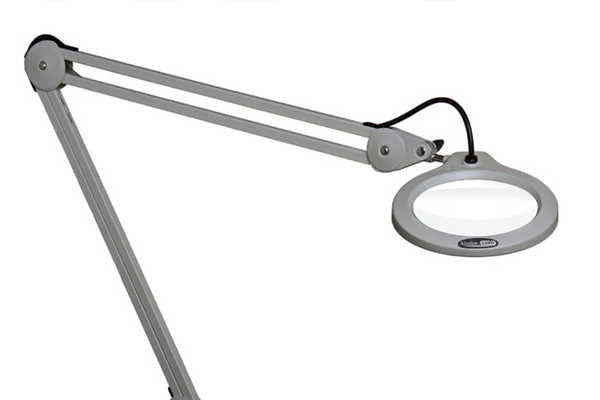
CE3S Vision LUXO Benchtop Magnifiers
Vision LUXO benchtop magnifiers provide magnification and task lighting for assembly, inspection, rework and production applications. Combine precision optics with Luxo’s K-arm positioning mechanism for distortion-free viewing, smooth adjustment and stable positioning during detailed manufacturing tasks. Five-year warranty. Intended for electronics manufacturing environments requiring enhanced visual inspection, operator comfort and workstation flexibility.
CE3S
ce3s.productionsupplystore.com
Collective Mind Vision AI Label Reader
Vision AI label reader automates label inspection, identification and data capture for goods-in and logistics operations. Uses AI-based image analysis to extract and interpret printed text, 1D and 2-D codes, and handwritten information across varying label formats, languages and code types. Powered by an IDS uEye CP industrial camera and engineered to handle reflective packaging, damaged codes and changing lighting conditions. Supports ERP integration, automated validation, traceability and inventory management workflows.
Collective Mind
Technical Abstracts
In Case You Missed It
PCB Materials
“A Molecular Pathway to Corrosion-Resistant Printable Copper”
Authors: Jun Zhang, et al.
Abstract: Copper’s exceptional electrical and thermal conductivities make it essential for electronics and energy systems. Oxidation and corrosion, however, limit its long-term reliability, and existing protection strategies often involve high-temperature or multistep processing. The authors report a molecularly reactive strategy that converts copper precursors to metallic copper at <150°C, while generating an ultrathin carbonaceous and copper(I) surface passivation. Catechol-based ligands mediate copper reduction, enable low-temperature interparticle fusion, and impart surface passivation, yielding flexible copper with low resistivity and exceptional stability (>1000 hr. in acid, >200 hr. in sulfide, >240 hr. at 140°C). This strategy resolves the long-standing tradeoff among conductivity, corrosion resistance and processability for next-generation flexible electronics and energy systems. (Science, May 14, 2026, vol. 392, no. 6,799, https://www.science.org/doi/10.1126/science.aed4488)
Read full article